


Any discussion about the safety of vaping needs to take place in the context of comparison to smoking. This is important for two reasons:
Electronic cigarettes are intended to be used as a harm-reducing alternative to smoking.
The vast majority of vapers are smokers or former smokers.
When we look at the studies that exist today, they don't always directly compare smoking to vaping, which can be confusing. We all know that smoking is very harmful to us. But is vaping harmful or carcinogenic? How does it affect our health? And most importantly, how much safer is vaping than smoking?

Vaping Vs Smoking - Is Vaping Carcinogenic?
A 2017 study in the journal Tobacco Control determined that the risk of cancer from vaping products is less than 1% compared to smoking, similar to other smoking alternatives such as nicotine patches or nicotine gum.
Other studies have also proven this claim, for example, in a 2016 study called mutation research, cigarettes and e-cigarettes were examined and their ability to cause mutations in cells.This study demonstrated that cigarette smoke causes cell mutations and is also toxic, but e-cigarette vapor does not cause cell mutations and is not toxic.
Nicotine itself is not carcinogenic, and long-term studies of smoking substitutes have shown no real link between them and the formation of cancer.

Another British study by the Royal College of Physicians, which investigated the use of smoking substitutes, including electronic cigarettes, determined that no link was found between long-term use of smoking substitutes and cancer.
The study also determined that proper use of an e-cigarette poses less than 1% of the risk compared to smoking a regular cigarette and is close in safety to a medical nicotine inhaler. Researching and understanding the harms of vaping separately is only part of the overall picture, as vaping exists primarily as an alternative to smoking.
Lung damage?
It is known for certain that tobacco smoking causes lung damage such as cancer, emphysema, chronic bronchitis, and chronic obstructive pulmonary disease.
What about e-cigarette vaping?
Regular cigarette smoke contains thousands of chemicals, about 70 of which are known carcinogens and about 300 more are suspected carcinogens. Tobacco smoke also contains tiny particles of hard material from the tobacco leaves and burning paper that lodge in the lungs.
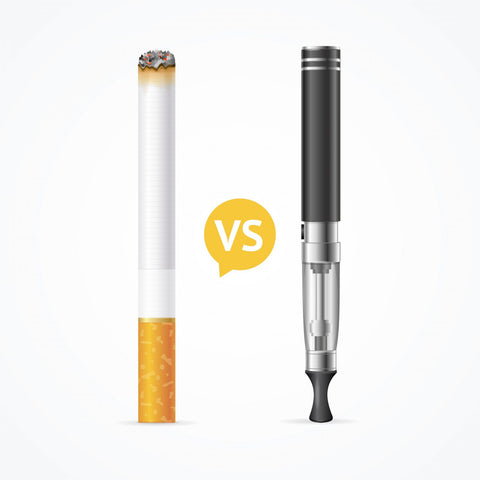
Vaping does not produce known carcinogens at levels that could be considered dangerous and does not contain particulate matter like cigarette smoke does. In fact, the things that cause most of the harm in a regular cigarette are not present in an e-cigarette. Because there is no combustion process, there is no tar and carbon monoxide, the two main harmful factors in smoking.
An electronic cigarette uses a coil that heats the liquid and turns it into vapor that we inhale. It looks like smoke, but it's not!
At the same time, it cannot be said that vaping is completely safe.
There are some concerns about the long-term effects of inhaling vegetable glycerin and propylene glycol, which are the main ingredients in e-cigarette liquid.
So far, extensive animal testing has shown no potential for harm, but more research is needed. In addition, propylene glycol may be allergenic or cause irritation to tissues in the throat.
Although those who suffer from an allergy to propylene glycol usually already know this because it is found in a variety of food additives, food colorings, cosmetics, and toothpastes.
Links to studies:
https://www.rcplondon.ac.uk/projects/outputs/nicotine-without-smoke-tobacco-harm-reduction-0
https://www.sciencedirect.com/science/article/pii/S1383571816301711